










How Does an Integrated Servo Motor Work?
 Sep 29, 2026|
 View:40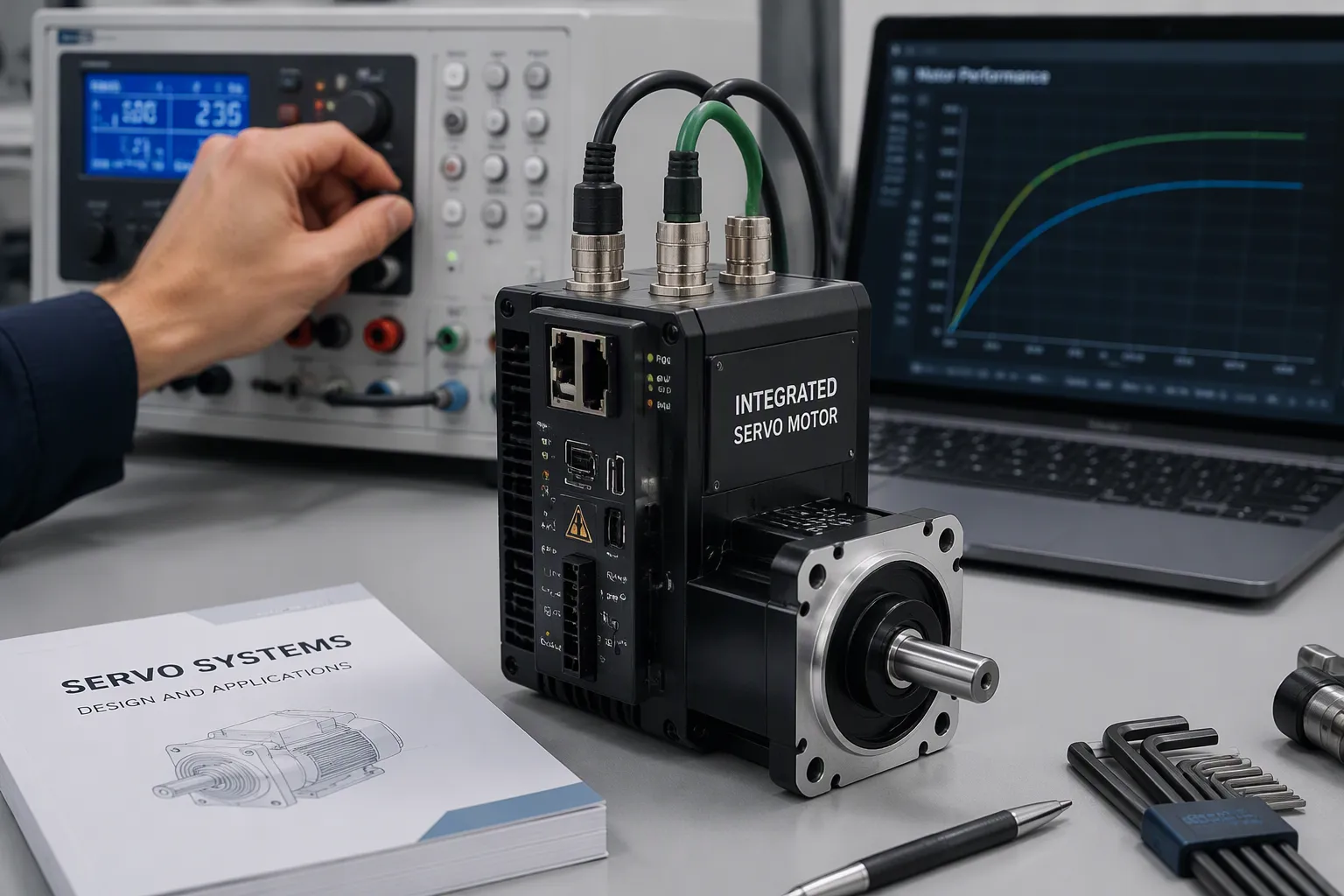
Quick Answer (Executive Summary)
An integrated servo motor merges the motor and drive controller into a single compact unit, eliminating external cabling and reducing cabinet space by up to 42%. As a premier custom motor manufacturer in China with over 20 years of experience, Baolong Motor specializes in integrated servo solutions featuring IP65 waterproof ratings, integrated electromagnetic brakes, and aviation plugs, widely used in collaborative robots (cobots), AGVs, and medical devices.
An integrated servo motor combines a servo motor and a drive controller into a single integrated unit for precise control. The motor generates motion and provides feedback. The drive controller powers and commands the motor. This article explains how these components interact and why integration offers advantages. An integrated servo motor simplifies machine design. It reduces wiring and saves space. The motor and drive work together as one system. This teamwork enables smooth, accurate motion in many applications. The controller reads feedback and adjusts power in real time. This closed-loop process keeps the motor on track. The result is reliable performance for demanding tasks.
Key Takeaways
Integrated servo motors combine motor and drive into one unit, reducing wiring and saving cabinet space.
Closed-loop feedback with encoders ensures precise motion control by constantly adjusting power.
Auto-tuning automatically sets control gains, simplifying setup and reducing commissioning time.
Predictive maintenance uses smart sensors to detect anomalies, extending motor lifespan and reducing downtime.
Manufacturer Backing: Supported by a 17,000 sqm manufacturing facility and 20+ years of motor expertise, Baolong ensures strict quality control and deep OEM/ODM customization for every integrated unit.
The Servo Motor's Role
How a Servo Motor Works
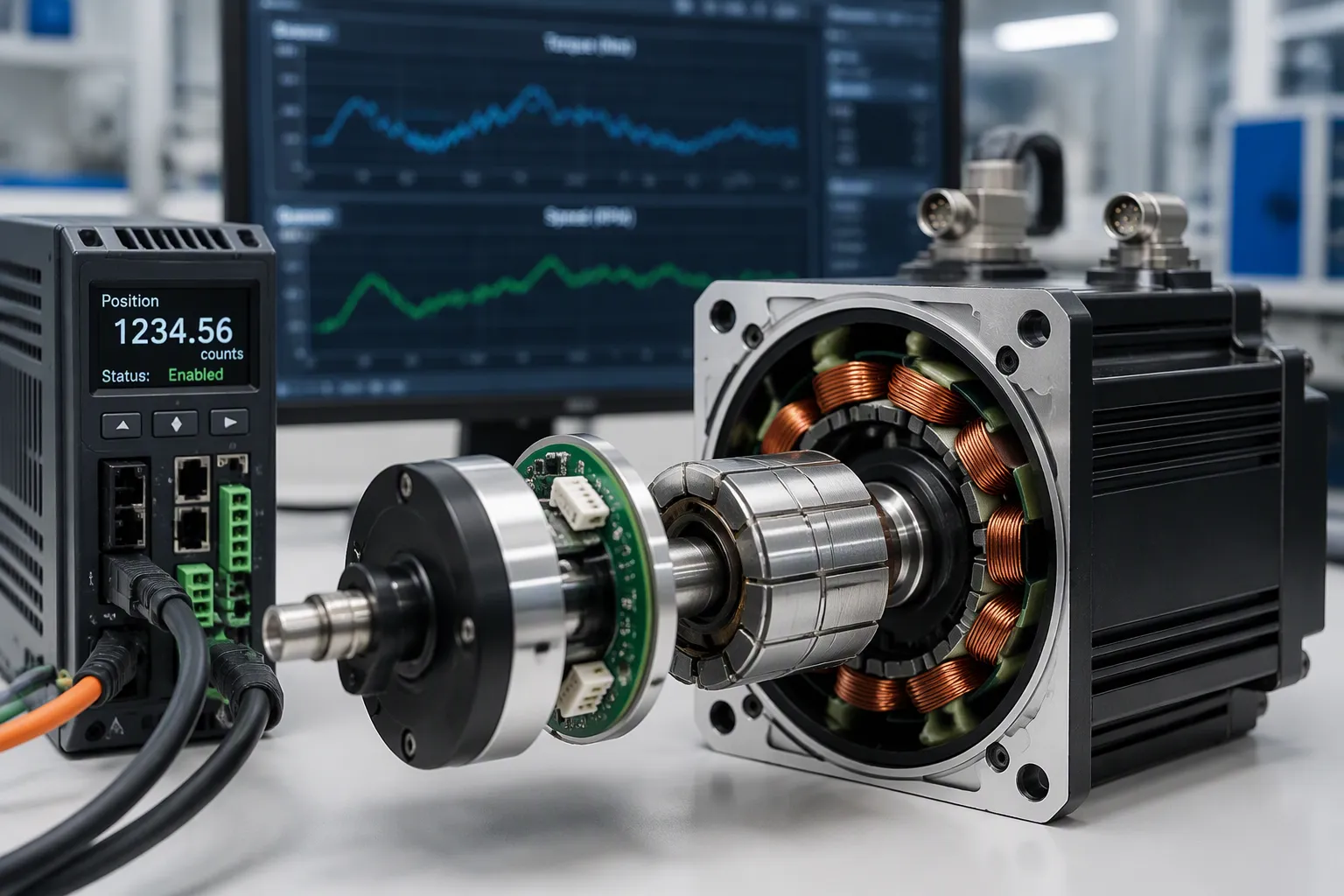
A servo motor is an electromechanical device. It combines a motor with feedback control. This combination allows the device to adjust its own motion. The motor produces rotation or linear movement. A controller sends commands to the motor. The motor then moves to a specific point. This process repeats continuously during operation.
Rare-earth magnets play a key role in modern servo motor design. Neodymium magnets provide the highest magnetic strength-to-weight ratio currently available. They generate a very strong magnetic field from a small amount of material. Engineers can reduce motor size and weight while maintaining high performance. Axial flux permanent magnet synchronous motors using rare-earth magnets achieve a higher torque-to-weight ratio. They require less core material and have a smaller size. These motors also use a planar and easily adjustable air gap. They produce lower noise and vibration. These design features make them superior to radial flux machines. This explains how rare-earth magnets improve torque-to-weight performance in servo applications.
Baolong Motor offers a comprehensive range of servo motors. The lineup includes square servo motors, circular servo motors, multipole torque servo motors, linear servo motors, and servo motors with integrated driver options. These motors serve many industries. Collaborative robots, medical equipment, textile machinery, industrial control, logistics, security, and rail transit all rely on these motors.
Feedback for Precision Control
Feedback sensors report position, speed, and torque back to the controller. Encoders are the most common feedback device. They track the motor shaft's exact location. The controller compares this data to the command signal. It then adjusts power to correct any error. This closed-loop process ensures precise motion control.
Encoder resolution affects positioning accuracy. Consider these practical guidelines:
Select encoder resolution at least 5–10 times finer than the required positioning accuracy.
For most precision applications, encoders rated at 1000–5000 PPR deliver excellent performance.
Beyond approximately 10,000 PPR, mechanical factors such as bearing runout, thermal expansion, and vibration typically become the dominant accuracy constraints rather than encoder specifications.
Environmental factors — heat/cold expansion, mechanical wear/backlash, and EMI/noise — can degrade real-world resolution regardless of the encoder's rated PPR.
Real-world tests on 400 W AC servo motor encoder setups in textile machinery showed ±0.02 mm positioning repeatability even with a 17-bit encoder — but only when cable shielding was properly earthed at the drive end. This demonstrates that high encoder resolution alone does not guarantee accuracy; electrical noise and grounding practices significantly affect the achievable positioning precision.
Higher encoder resolution enables smoother speed control. It reduces quantization noise and allows higher controller gains. It also improves torque quality at low speeds. However, resolution and accuracy are fundamentally different. A 20-bit encoder provides 1,048,576 discrete positions per revolution. Yet the actual positioning accuracy depends on manufacturing tolerances and mechanical constraints. It does not depend on the encoder's resolution specification alone.
The Drive Controller's Role
Powering the Motor
The unit serves three essential functions. It acts as a command unit, an amplifier, and a power source for the motor. It receives a signal from a motion source. This signal tells the motor what position, speed, or torque to achieve. The assembly amplifies the low-power command signal into high-power electrical signals. These signals then flow to the motor windings to generate motion.
An integrated unit delivers impressive power in a compact package. Continuous power output reaches up to 1500 W. Peak power capability reaches up to 4500 W. This high power density results from advanced electronics and effective switching technology. The compact design reduces heat generation. The motor and unit work together as a perfectly tuned system for powering and controlling the servo motor. This integration optimizes servo motor characteristics for each specific application.
The Servo Drive's Function
The motor operates within a closed feedback loop controlled by the drive controller. This circuit processes encoder inputs and compares the actual position to the commanded position. The unit then adjusts the power output to correct any error. This cycle repeats thousands of times per second.
Field-oriented control (FOC) is the core algorithm behind modern high-performance drive technology. FOC transforms three-phase stator currents from the stationary abc reference frame into a rotating dq reference frame. This transformation decouples torque and flux components. The drive controller can then control torque and magnetism independently. PI regulators manage the dq currents to achieve the desired torque and speed. FOC achieves efficiency as high as 97% in certain applications. In a high-speed blower test at the same 24V supply, Hall-based commutation drove the spindle at 17,895 RPM. FOC drove it at 29,310 RPM, about 64% faster.
It also uses additional control algorithms for precision. PID control provides proportional, integral, and derivative correction for stiffness, static loads, and damping. Feedforward control preemptively adjusts signals based on desired motion. Velocity feedforward compensates for viscous friction. Acceleration feedforward compensates for inertia. These feedforward gains reduce following error without affecting stability. The result is smooth operation at low speeds and dynamic torque response for rapidly changing loads. These features make the motor system essential for applications like robotics and precision positioning.
How Motor and Driver Integrate
Closed-Loop Control
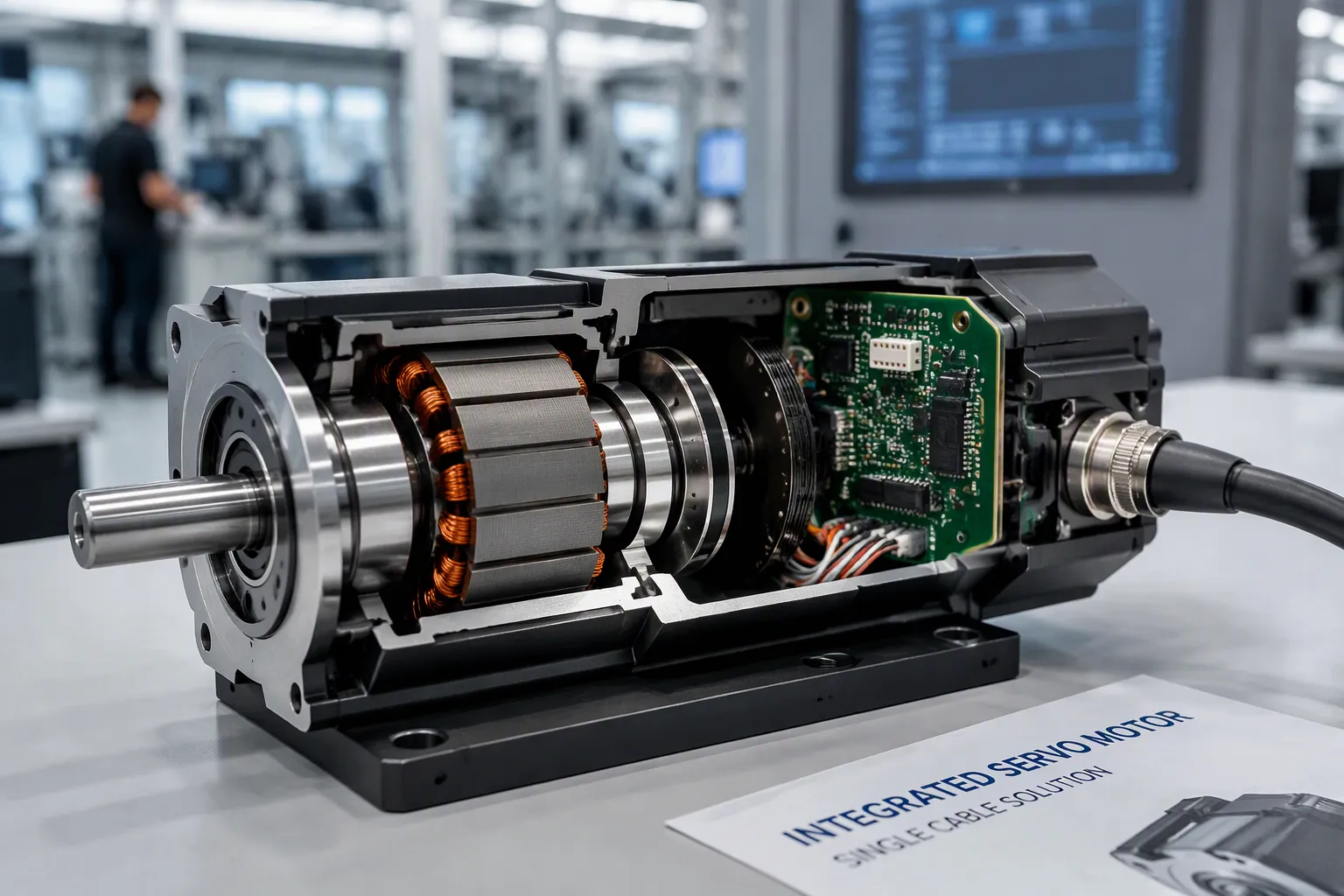
Integration synchronizes the motor, controller, and encoder into one system. This teamwork produces high accuracy and repeatability. The encoder feeds position data directly to the drive electronics inside the housing. No external signal path exists between them. The control loop therefore runs with minimal delay and noise.
Closed-loop bandwidth determines how fast a system responds to changing commands. Test data on integrated servo platforms shows clear gains from advanced filtering. A baseline PI controller with no filtering reaches 23 Hz closed-loop bandwidth. Adding a single-pole low-pass filter at 50 Hz raises bandwidth to 35 Hz. A bi-quadratic filter pushes it to 56 Hz. A bi-quadratic filter plus acceleration feedback achieves 77 Hz. Higher bandwidth means tighter tracking and faster settling for high-dynamic tasks.
This tight coupling supports smooth and accurate motion control in demanding applications. The servo motor responds to commands without the lag that afflicts separate motor and drive components. Each correction cycle happens inside one sealed enclosure. Electrical noise stays low. The result is stable performance across the full speed range.
Wiring and Space Savings
Traditional motion systems carry many external connections. A conventional setup has at least six groups of failure points: the power supply cable, the driver unit, the driver-to-motor power cable, the driver-to-motor feedback cable, the motor, and multiple connectors. Field data shows that over 70% of servo failures are connector or cable related. Reducing connections directly improves mean time between failures.
An integrated servo motor collapses the drive, power cables, and feedback cables into one unit. Only a single power and communication cable plus the motor body remain. Power, I/O, and communications plug directly into the motor's connectors. No cables run between the drive and the motor. This design removes the most common failure sources.
Aspect | Integrated Servo Motor (Baolong) | Traditional Servo Motor |
|---|---|---|
External cable connections | 2–4 | 6–12 |
Risk of loose or corroded connectors | Low | High |
Cable length as noise antenna | Short (<3 m) | Long (often >10 m) |
The layout freedoms are substantial. Integration reduces the amount of wiring and saves space inside the cabinet. Machine builders can shrink enclosures or add function where limited room once blocked progress. At Baolong Motor, we take integration a step further by offering deep customization. Our engineering team can integrate electromagnetic brakes directly into the housing, customize shaft dimensions for unique robot arms, and configure aviation plugs to ensure an IP65 waterproof rating for harsh industrial environments. These tailored options bring seamless integration to robots, medical equipment, and logistics systems, ensuring your design is perfectly matched without compromise.
Benefits of Integration
Advanced Features
An integrated servo motor simplifies setup and troubleshooting. Auto-tuning routines inject controlled signals and measure the torque-to-velocity relationship. The drive then identifies inertia, resonance frequencies, and friction. It calculates control gains automatically. This process takes seconds for simple loads and under a minute for complex systems. Manual tuning can take 30 minutes to several hours per axis. Auto-tuning also produces rich diagnostic data, including frequency response functions and Bode plots.
Predictive maintenance represents another advanced feature. Smart sensors connect the motor to the industrial internet. AI algorithms analyze vibration, torque, and power consumption data. Anomaly detection identifies unusual patterns before failures occur. Remaining Useful Life models estimate operating hours before component replacement. This shifts maintenance from reactive to predictive approaches. The result is reduced downtime and extended motor lifespan.
Efficiency and Versatility
Integration cuts installation time significantly. According to an industry study cited by HCY Automation, switching from traditional discrete servo setups to all-in-one integrated solutions reduces installation time by 30% and wiring complexity by 42%.
Evaluation Metric | AC Servo (Traditional) | Integrated BLDC Servo (Modern / Baolong) |
|---|---|---|
Initial Hardware CapEx | High ($350–$800 per axis) | Moderate-High ($280–$550 complete unit) |
Cabinet Space & Cooling | Large IP54 cabinet + forced-air fans | Zero cabinet footprint |
Harnessing & Assembly Labor | High: 8–12 wires per axis | Ultra-low: 4 wires total |
Maintenance & MTBF | >30,000 hours | >40,000 hours |
The compact design eliminates external drive cabinets. Machine builders gain layout freedom. Wire termination time drops from roughly 2.5 hours per axis to about 15 minutes per axis. Factory assembly labor costs fall by up to 60–70%.
These benefits extend across industries. Collaborative robots, medical equipment, textile machinery, logistics systems, security devices, and rail transit all use this technology. Baolong Motor stands behind its products with a warranty covering free replacement for quality issues. The company also provides strong after-sales support. This commitment ensures precise and reliable performance throughout the machine's life.
An integrated servo motor merges a motor and a drive controller into one compact unit. This design delivers precise control for demanding tasks. The integrated package reduces wiring and saves valuable cabinet space. Advanced features like auto-tuning simplify setup and troubleshooting. Ease of use improves because fewer connections mean fewer failure points. Machine builders gain layout freedom and faster commissioning. The servo motor responds smoothly across the full speed range. This integrated approach continues to prove its efficiency and versatility across motion control applications. As industries demand smaller, smarter systems, the motor will keep driving innovation forward.
Ready to Optimize Your Motion Control System?
Whether you need a compact integrated servo motor for your next Cobot or a high-torque multipole motor for AGVs, Baolong's engineering team is ready to help with custom designs.
Request a Custom QuoteDownload CatalogFAQ
What is the difference between an integrated servo motor and a traditional system?
An integrated servo motor combines the drive controller and motor into one unit. Traditional systems have separate components with many external cables. Integration reduces wiring, saves cabinet space, and improves reliability.
How does the motor achieve precise motion control?
The motor uses closed-loop feedback from an encoder. The drive controller reads position data and adjusts power instantly. This constant correction cycle keeps motion accurate.
What are the main benefits of integration?
Benefits include reduced wiring, smaller cabinets, faster commissioning, and fewer failure points. Auto-tuning simplifies setup. Predictive maintenance reduces downtime.
Is an integrated servo motor difficult to install?
No. Installation requires only a single power and communication cable to the motor. No cables run between drive and motor. Baolong Motor's designs further simplify the process.
What applications benefit most from these motors?
Collaborative robots, medical equipment, textile machinery, logistics, security, and rail transit all benefit. The compact, precise design suits demanding motion tasks.


Recent News
1.Servo Motor Sizing Guide: 5 Critical Parameters You Must Not Ignore
2026-09-082.AC Servo Motor vs DC Servo Motor for Industrial Applications
2026-08-143.Big servo motor makes industrial automation easier now
2026-06-114.How to Choose the Right Servo Motor for Your Application: A Complete 2026 Guide
2026-04-245.What is an Industrial Servo Motor and How Does It Work
2026-06-226.What is An Industrial Servo Motor? A Complete Guide to It's Features and Uses
2025-07-10