










Servo Motor Sizing Guide: 5 Critical Parameters You Must Not Ignore
 Sep 08, 2026|
 View:99
Choosing the wrong servo motor is one of the most expensive mistakes in motion control design. An undersized motor overheats, trips overload alarms, and fails prematurely. An oversized motor inflates your BOM cost, wastes cabinet space, raises rotor inertia, and can even destabilize the servo loop. In this ultimate servo motor sizing guide, the application engineers at Baolong Motor break down the 5 critical parameters you must verify before placing a purchase order. Follow this checklist and you will get it right the first time.
Key Takeaways
Torque calculations must distinguish between continuous (RMS) and peak requirements.
Speed and the torque-speed curve dictate your motor's operational limits, especially with gearboxes.
Inertia ratio is the silent killer of dynamic performance and must be matched to your application.
Duty cycle and thermal limits ensure the motor survives continuous 24/7 operation.
Feedback resolution must be matched to the process requirements to avoid unnecessary costs.
Why Proper Servo Motor Sizing Matters More Than You Think
Before diving into the parameters, it helps to understand what goes wrong when sizing is skipped or done incorrectly:
Symptom | Typical Root Cause |
|---|---|
Motor overheats, drive trips "overload" | RMS torque exceeds continuous rating |
Positioning errors, poor settling time | Inertia ratio too high |
Axis stalls during fast acceleration | Peak torque underestimated |
Project budget blown, cabinet too full | Motor oversized "just to be safe" |
The goal of servo motor selection is simple: match the motor to your actual motion profile—not to the machine's nameplate.
Parameter #1: Torque — Continuous (Rated) vs. Peak Torque
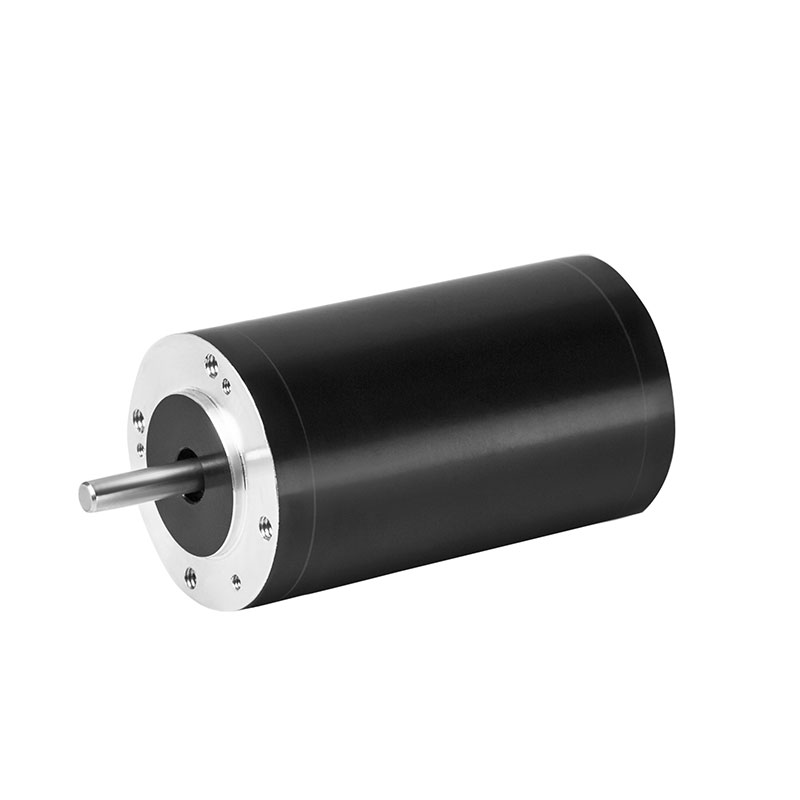
Torque is where every sizing exercise begins. A servo motor datasheet lists two fundamentally different numbers:
Continuous (rated) torque: the torque the motor can deliver indefinitely without exceeding its thermal limit.
Peak torque: the short-duration torque available for acceleration and deceleration, typically 2–3× the continuous rating.
How to calculate the torque you actually need
For each axis, sum all torque components at the worst-case operating point: T_total = T_acceleration + T_friction + T_gravity + T_external. Then apply these engineering rules:
Add a safety factor of 1.2–1.5 to your calculated load torque.
Keep your acceleration torque below 80% of the catalog peak torque.
Plot every (speed, torque) point of your motion profile on the manufacturer's torque-speed curve.
Pro tip: High-torque-density designs, such as Baolong's multipole torque servo motors, deliver more torque in the same frame size—ideal when your machine envelope is fixed but your load has grown.
Parameter #2: Speed and the Torque-Speed Curve
The second critical parameter is speed—but not just "max speed." You must understand where on the torque-speed curve your application lives. Below the rated (base) speed, the motor delivers constant torque. Above base speed, back-EMF approaches the drive's bus voltage limit, and available torque drops sharply.
Don't forget the gearbox
If you use a gearbox, remember: Motor speed = Load speed × Gear ratio. Always verify that the resulting motor speed stays below both the motor's max speed and the gearbox's max input speed. High reduction ratios multiply torque but also multiply reflected speed demands on the motor side.
Parameter #3: Inertia Ratio — The Silent Killer of Dynamic Performance
Inertia ratio is the parameter most often ignored—and the one that causes the most field complaints. A high inertia ratio makes the servo loop sluggish and difficult to tune: longer settling times, overshoot, oscillation, and mechanical resonance.
Recommended inertia ratios by application
Application Type | Recommended Ratio (J_load : J_motor) |
|---|---|
General automation, conveyors | ≤ 10:1 |
Pick-and-place, packaging | ≤ 5:1 |
Robotics, high-dynamic CNC axes | ≤ 3:1 |
How to fix a bad inertia ratio
Add or increase a gearbox: reflected inertia drops by the square of the ratio.
Select a motor with a larger rotor inertia (often a bigger frame size).
Redesign the mechanics: lighten the moving load or reduce the radius of gyration.
Parameter #4: Duty Cycle and Thermal Limits (RMS Torque)
A servo motor that survives a 3-second move can still burn out in an 8-hour shift. That is why duty cycle and RMS (root-mean-square) torque are non-negotiable checks. Calculate the RMS torque for your cyclic motion profile and ensure it is less than or equal to the motor's continuous torque, with extra margin if ambient temperature exceeds 40°C. Pairing your motor with a properly matched servo drive ensures the current loop can actually deliver the torque your profile demands.
Parameter #5: Feedback Resolution and Encoder Type
The last parameter determines whether your beautifully sized motor can actually control the axis precisely.
Resolution: Combined with your screw pitch or gear ratio, this defines the smallest controllable movement.
Incremental vs. absolute: Absolute encoders eliminate homing after power loss; multi-turn absolute versions suit rotary axes that rotate beyond 360°.
Match to the application: Simple speed control tolerates lower resolution; contouring CNC and robotics demand high-resolution absolute feedback.
Bonus: 3 More Checks Before You Order
Bus voltage & control interface: Verify voltage class, control mode, and fieldbus compatibility.
Environment: Check IP rating, ambient temperature, and cleanroom requirements for medical tools.
Mechanical envelope: Short on space? A servo motor with integrated driver can cut wiring and cabinet volume dramatically.
Servo Motor Sizing Checklist
Continuous torque ≥ 1.2–1.5 × calculated load torque
Peak torque usage < 80% of catalog peak
All motion-profile points inside the torque-speed curve
Inertia ratio within application guideline
T_rms ≤ continuous torque, derated for ambient conditions
Encoder type & resolution matched to positioning requirements
FAQ
How do I calculate the torque needed for a servo motor?
Sum acceleration, friction, gravity (vertical axes), and external torque at the worst-case point, then apply a 1.2–1.5 safety factor and verify against the torque-speed curve.
What is a good inertia ratio for servo motors?
≤10:1 for general automation, ≤5:1 for pick-and-place, and ≤3:1 for robotics and high-dynamic CNC axes.
Can I run a servo motor continuously at peak torque?
No. Peak torque is for short acceleration phases only. Continuous operation must stay at or below the rated (continuous) torque, verified by RMS torque calculation.
How does a gearbox affect servo motor sizing?
A gearbox multiplies output torque by the ratio and divides reflected load inertia by the ratio squared, but it also multiplies required motor speed—check all three.
Get Your Sizing Right—With a Partner of 20+ Years
Servo motor sizing is where machine reliability is decided. At Baolong Motor, our own factory, complete production processes, and 24-hour engineering support mean your calculated parameters become a motor that performs exactly as designed—on time and on budget.


Recent News
1.How 12V Servo Motors Empower Precise and Dynamic Motion Control
2023-08-252.What are 24 volt servo motor used for?
2024-06-273.What is the durability of servo motor:Taking 24V servo motor as an example
2024-09-034.What is An Industrial Servo Motor? A Complete Guide to It's Features and Uses
2025-07-105.Big servo motor makes industrial automation easier now
2026-06-11