








Hall Sensor vs. Sensorless BLDC Motor: Key Differences
 Oct 22, 2026|
 View:4
Quick Answer (Executive Summary)
A Hall sensor BLDC motor uses physical Hall-effect sensors to report rotor position, so the controller knows where the rotor is before the motor turns — making startup under load and low-speed commutation straightforward. A sensorless BLDC motor estimates rotor position from electrical signals such as back-EMF, removing sensors and their wiring to cut component cost and harness complexity, at the price of a more demanding startup sequence. As a premier custom motor manufacturer in China with over 20 years of experience, Baolong Motor supplies BLDC motors for industrial equipment together with the perfectly matched BL Series Brushless Motor Drives, helping OEM buyers balance startup performance, wiring complexity, and total system cost.
When selecting a brushless DC (BLDC) motor for industrial equipment, automation systems, or OEM products, one important decision is whether to use a Hall sensor BLDC motor or a sensorless BLDC motor. Both options offer the advantages of brushless motor technology, including high efficiency, compact design, and reduced mechanical maintenance. However, they differ in how rotor position is detected and how the motor controller manages commutation.
Hall sensor BLDC motors use physical magnetic sensors to detect rotor position, while sensorless BLDC motors estimate rotor position from electrical signals generated during operation. This difference affects startup performance, low-speed operation, wiring requirements, system complexity, and overall cost. This guide compares both configurations to help engineers, equipment manufacturers, and OEM buyers select the right motor configuration for their applications.
Key Takeaways
Hall sensors report rotor position at standstill, so startup under load and low-speed commutation remain predictable.
Sensorless control removes Hall sensors, sensor wiring, and alignment work, reducing component count and assembly cost.
Conventional back-EMF sensorless control is weak at low speed and absent at standstill, so it needs a dedicated startup strategy.
The right choice depends on startup torque, minimum operating speed, load profile, and total system cost — not on the sensor type alone.
Manufacturer Backing: Baolong Motor supplies BLDC motors for industrial equipment and the matched BL Series Brushless Motor Drives, reducing compatibility risk and tuning time, backed by our 17,000 sqm manufacturing facility.
1. What Is a Hall Sensor BLDC Motor?
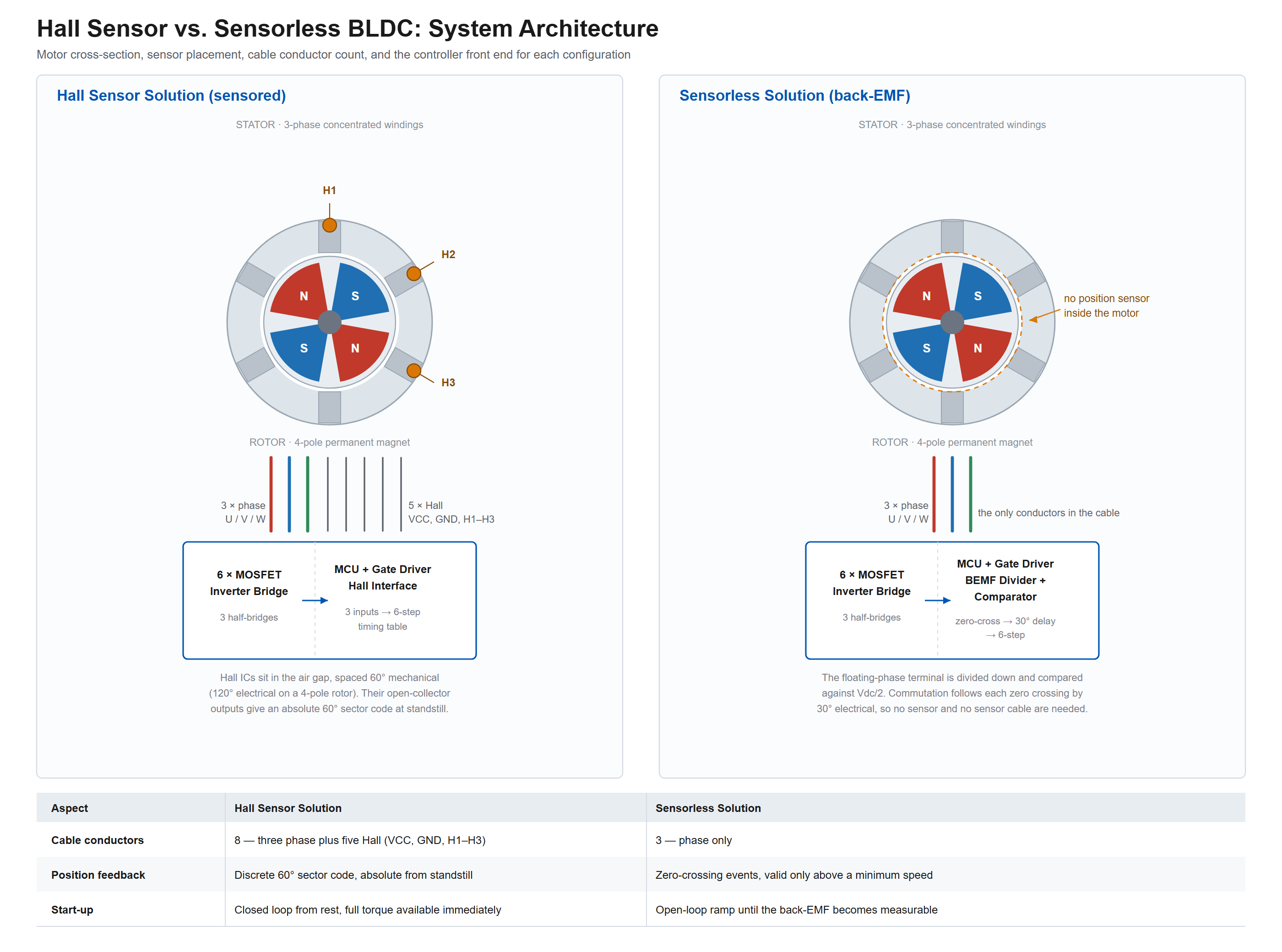
A Hall sensor BLDC motor uses Hall-effect sensors to detect the magnetic field produced by the rotor's permanent magnets. These sensors generate electrical signals that indicate the rotor's position relative to the stator.
In a conventional three-phase BLDC motor using six-step commutation, three Hall sensors commonly provide digital signals that identify the rotor's electrical sector. The motor controller uses this information to determine when to energize the appropriate stator windings.
Because the sensors can detect rotor position even when the motor is stationary, Hall sensor systems can provide reliable initial position information for startup and low-speed operation.
Key Advantages of Hall Sensor BLDC Motors
Reliable startup: Rotor position is available before the motor begins rotating.
Better low-speed feedback: Hall signals support commutation when back-EMF signals are weak.
Predictable operation under changing loads: The controller can use rotor-position signals during acceleration and speed changes.
Straightforward commutation: Conventional Hall-based six-step control is relatively simple to implement.
Potential Limitations
Hall sensor motors require additional sensors, wiring, connectors, and associated electronics. These components can increase manufacturing and integration costs. The sensors and their wiring must also be protected against excessive temperature, vibration, and electromagnetic interference where applicable.
2. What Is a Sensorless BLDC Motor?
A sensorless BLDC motor operates without physical Hall sensors for rotor position detection. Instead, its controller estimates rotor position using electrical measurements and a suitable control algorithm.
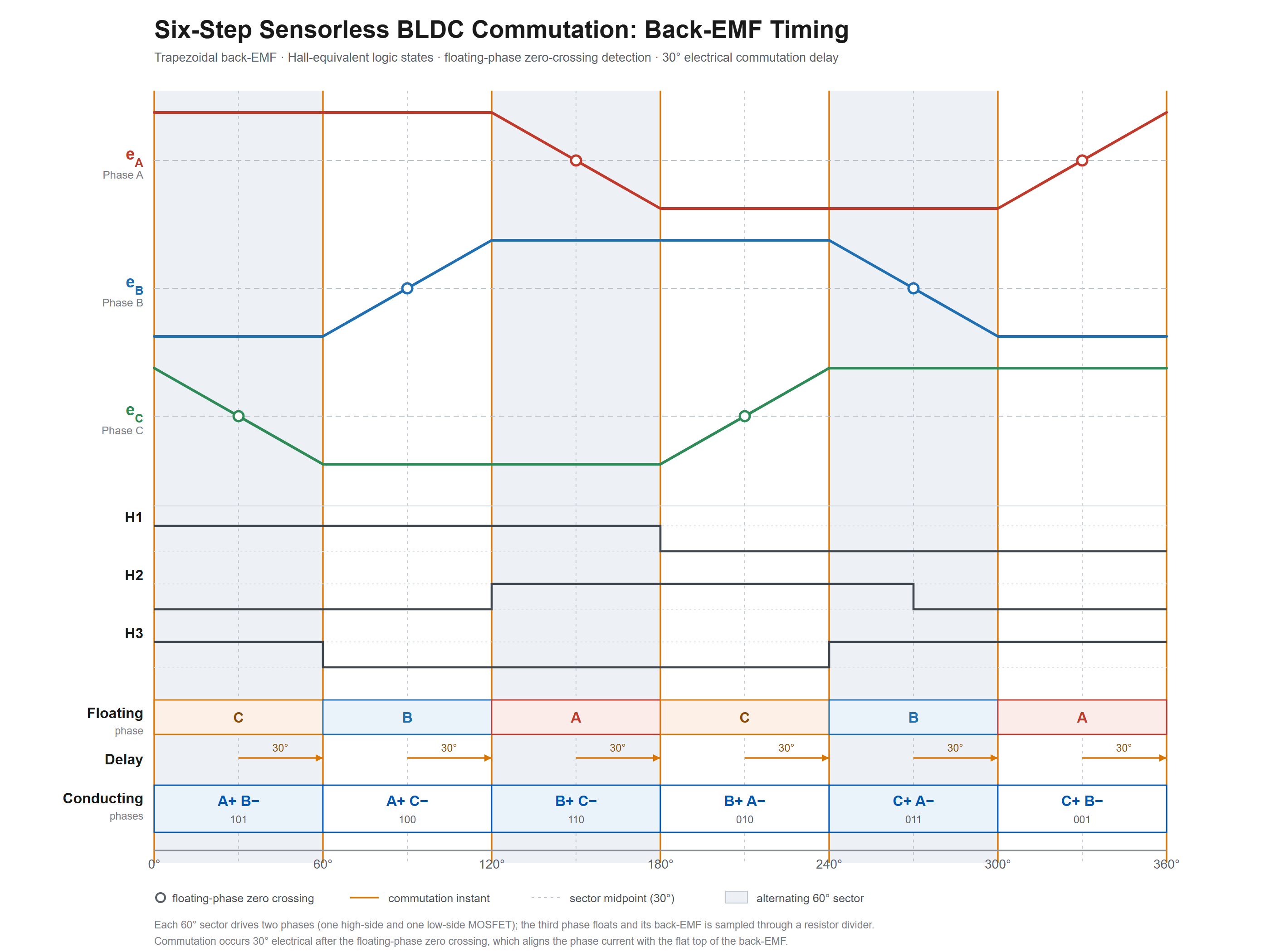
In conventional six-step sensorless control, the controller monitors the back electromotive force (back-EMF) generated in an unpowered motor phase. By detecting characteristic changes in this voltage, the controller estimates rotor position and determines the timing of subsequent commutation events.
More advanced sensorless control methods may use observers, motor models, or other estimation techniques. Their operating capabilities depend on the control algorithm, motor characteristics, and implementation.
Key Advantages of Sensorless BLDC Motors
Fewer physical components: Hall sensors and their associated wiring are not required.
Potentially lower system cost: Removing sensors can reduce component, assembly, and wiring costs.
Simpler motor construction: No Hall sensor installation or alignment is needed.
Compact integration: Sensorless designs can be useful where installation space is limited.
Fewer sensor-related failure points: The system does not depend on physical Hall sensor signals for commutation, although other electrical and mechanical faults remain possible.
Potential Limitations
In conventional back-EMF-based sensorless control, the back-EMF signal is weak at very low speeds and is absent at standstill. The controller must therefore use a startup strategy to accelerate the motor until sufficient position information becomes available.
This can make startup more challenging when the motor starts under a heavy load or must operate at very low speeds. Sensorless control may also require more sophisticated signal processing and careful tuning to maintain stable operation under changing loads.
3. Hall Sensor vs. Sensorless BLDC Motor: Key Differences
The main difference is how the controller obtains rotor-position information. This affects the motor's behavior at startup, its low-speed performance, wiring requirements, and the complexity of the complete control system.
Comparison Factor | Hall Sensor BLDC Motor | Sensorless BLDC Motor |
|---|---|---|
Rotor position detection | Physical Hall-effect sensors | Electrical measurements and position estimation |
Startup from standstill | Position information is available at zero speed | Requires a suitable startup strategy |
Low-speed operation | Generally well suited to low-speed commutation | Depends on the control algorithm; conventional back-EMF methods are limited at very low speeds |
Sensor wiring | Additional sensor wiring is required | No Hall sensor wiring is required |
Motor construction | Requires sensor installation and alignment | No physical Hall sensor installation is needed |
Control system | Hall signal processing and commutation logic | Position estimation and sensorless control algorithms |
System cost | May be higher due to sensors and assembly | May be lower due to fewer physical components |
High-speed operation | Suitable when motor and driver ratings permit | Suitable when the estimation method and system design support the required speed |
Typical applications | Equipment requiring dependable startup and low-speed operation | Fans, blowers, and pumps with suitable speed and load requirements |
Neither configuration is universally better. The appropriate choice depends on the required startup behavior, speed range, load profile, control performance, available installation space, and total system cost.
4. How Do Hall Sensors and Sensorless Control Work?
Hall Sensor-Based Commutation
Hall sensors detect changes in the magnetic field as the rotor moves. Their digital outputs provide rotor-position information to the motor controller. In a conventional three-phase, six-step BLDC system, the controller uses the Hall signal states to select the appropriate commutation sequence.
Because the sensors provide position information without requiring the motor to rotate first, Hall-based control is useful when the motor must start reliably from standstill or maintain controlled operation at low speeds.
Sensorless Back-EMF-Based Commutation
During rotation, the permanent magnets moving relative to the stator windings generate back-EMF. In conventional six-step sensorless control, the driver monitors the voltage of an unpowered phase and detects characteristic voltage transitions to estimate the rotor's electrical position.
Since back-EMF magnitude generally increases with rotational speed, position estimation becomes more difficult at startup and very low speeds. The controller must first bring the motor into a suitable operating region or use a control method designed to estimate rotor position at low or zero speed.
This limitation should be evaluated against the actual application. Not all sensorless control methods have identical startup and low-speed performance.
5. Startup, Low-Speed Operation, and Cost
Which Is Better for Startup and Low-Speed Operation?
If an application requires dependable startup from a stationary rotor, Hall sensor feedback is often a practical choice. The controller can identify the initial rotor position and select the appropriate commutation state without waiting for a measurable back-EMF signal.
This can be especially important when the motor must start under load, accelerate predictably, or run at a low speed for extended periods.
Sensorless systems can also achieve effective startup and low-speed operation when equipped with suitable control algorithms. However, conventional back-EMF zero-crossing methods face inherent limitations at standstill and very low speeds.
Before selecting a motor, evaluate the required startup torque, load inertia, minimum operating speed, acceleration time, and frequency of starts and stops. These operating requirements are often more important than the sensor configuration alone.
Which Option Is More Cost-Effective?
Sensorless BLDC motors can reduce hardware and assembly costs by eliminating Hall sensors, sensor wiring, and related installation requirements. They can be attractive for high-volume products where the application is compatible with sensorless operation.
Hall sensor motors introduce additional components and wiring, but they can simplify startup and rotor-position detection. For applications with demanding startup conditions, this can reduce the difficulty of achieving the required behavior.
A fair cost comparison should consider the complete system rather than the motor alone. Relevant factors include:
Motor and driver purchase cost.
Sensor wiring, connectors, and assembly.
Controller hardware and software requirements.
Startup performance and application-specific tuning.
Installation, troubleshooting, and service requirements.
The most economical solution is the one that meets the performance requirements with an appropriate balance of component cost, engineering effort, and long-term operating needs.
6. Applications and Selection Guide
Applications for Hall Sensor BLDC Motors
Hall sensor BLDC motors are worth considering when an application requires reliable initial rotor-position detection, frequent starting, or stable commutation at low speeds.
Industrial automation equipment with frequent start-stop cycles.
Motorized mechanisms that start under a variable mechanical load.
Equipment requiring predictable low-speed operation.
Compact drive systems that benefit from direct rotor-position feedback.
Applications for Sensorless BLDC Motors
Sensorless BLDC motors are often suitable for applications where the motor can accelerate into a stable operating range and physical sensor integration is unnecessary.
Cooling fans and ventilation systems.
Blowers operating within a suitable speed range.
Pumps with compatible startup and load characteristics.
Space-constrained equipment where reducing sensor wiring is beneficial.
These are general selection examples rather than absolute rules. The final choice depends on the motor design, controller capabilities, required speed range, and actual load conditions.
Step-by-Step Selection Checklist
Step 1 — Define startup requirements: Determine whether the motor must start under load, restart frequently, or begin rotating reliably from any initial rotor position.
Step 2 — Identify the speed range: Check the minimum continuous operating speed, target speed, acceleration time, and speed variation under load.
Step 3 — Evaluate load characteristics: Consider starting torque, load inertia, sudden load changes, and operating duty cycle.
Step 4 — Confirm driver compatibility: Verify that the selected driver supports the motor's feedback method, supply voltage, current requirements, control signals, and commutation strategy.
Step 5 — Compare total system cost: Compare sensor hardware, wiring, controller requirements, installation space, tuning effort, and maintenance considerations.
Field experience shows that many "weak motor" complaints in low-speed positioning, AGV, and medical device applications trace back to commutation timing at startup rather than to insufficient torque. When a machine must start under load, hold position at zero speed, or reverse frequently, Hall feedback usually shortens commissioning time and reduces field failures — even though the motor itself carries a higher unit cost. Always validate the complete motor and drive combination under the real load profile before freezing the design.
Hall sensor and sensorless BLDC motors both offer advantages, but they address different design priorities. Hall sensor feedback provides direct rotor-position information that can simplify startup and low-speed commutation. Sensorless control eliminates physical Hall sensors and their wiring, potentially reducing system cost and mechanical complexity. The right choice depends on the application's startup requirements, minimum operating speed, load characteristics, control performance, available space, and total system cost. Evaluating these factors early can help equipment manufacturers select a motor configuration that meets both performance and integration requirements.
Baolong provides brushless DC motor solutions for a range of industrial applications. Explore the Baolong BLDC motor product range to learn more about available motor options. For applications requiring compatible motor control, review the matched BL Series motor drives and contact the Baolong team to discuss your technical requirements.
Choose the Right BLDC Motor Configuration
Get free sizing recommendations and custom OEM/ODM designs from Baolong's engineering team.
FAQ
What is the main difference between a Hall sensor and a sensorless BLDC motor?
A Hall sensor BLDC motor uses physical magnetic sensors to detect rotor position. A sensorless BLDC motor estimates rotor position from electrical signals and a suitable control algorithm. This difference affects startup behavior, low-speed operation, wiring, and controller design.
Is a Hall sensor BLDC motor better for low-speed applications?
Hall sensor feedback is often advantageous for conventional BLDC control at low speeds because rotor-position information remains available when back-EMF is weak. Advanced sensorless methods can also support low-speed operation, depending on the implementation.
Are sensorless BLDC motors cheaper?
They can be less expensive to manufacture because they do not require Hall sensors or associated sensor wiring. However, the total cost also depends on the motor driver, control algorithms, system integration, and application requirements.
Can a sensorless BLDC motor start from zero speed?
Yes, sensorless BLDC systems can start from standstill using appropriate startup strategies. However, conventional back-EMF-based control cannot directly obtain rotor position from back-EMF at zero speed, so the startup process requires special handling.
Can the same BLDC motor operate with either Hall-based or sensorless control?
In some cases, a Hall-equipped motor can be operated by a compatible sensorless controller if the motor's electrical characteristics and control requirements permit it. However, compatibility is not guaranteed. Confirm the motor and driver specifications before attempting a different control configuration.
How do I select the right BLDC motor for my application?
Start by defining the required voltage, continuous and peak torque, operating speed, startup load, duty cycle, and control method. Then determine whether Hall feedback is necessary and verify that the motor and driver are compatible with the application.


Recent News
1.Top 10 Brushless Motor Manufacturer for 2026: Expert Guide to Choosing the Right Supplier
2024-07-122.How Does a BLDC Motor Work: A Detailed Explanation of the Principles of Brushless DC Motors
2025-04-183.Why Choose a 48V DC Brushless Motor Over a Brushed Motor
2024-12-314.Brushless DC Motor vs. Stepper Motor: Which is Better for Your Automation Project?
2026-03-135.What Does KV Mean for Brushless Motors: Your Complete Guide to Motor Speed Ratings
2025-12-126.Maintenance and Troubleshooting Tips for 48V DC Brushless Motors
2024-12-16