










Brushless DC Motor vs. Stepper Motor: Which is Better for Your Automation Project?
 Mar 13, 2026|
 View:444
Quick Answer: Brushless DC motors excel in high-speed, continuous-duty applications requiring maximum efficiency (up to 90%), while stepper motors dominate precision positioning tasks with exceptional accuracy (±5% step error). The choice depends on specific requirements: BLDCs for speed-critical operations, steppers for cost-effective positioning control.
What Are the Core Differences Between Brushless DC Motors and Stepper Motors?
Understanding motor technology fundamentals is essential for automation success. Brushless DC motors (BLDCs) use electronic commutation and permanent magnets to deliver continuous rotation with variable speed control. According to industry data, BLDCs achieve efficiency ratings between 85-90%, significantly outperforming traditional brushed motors.
Stepper motors operate on a different principle—converting electrical pulses into discrete mechanical movements. Each pulse rotates the motor shaft by a precise angle, typically 1.8° (200 steps per revolution). This digital nature eliminates the need for feedback systems in many applications, reducing system complexity.
The fundamental operational difference manifests in control methodology. BLDCs require encoder feedback for position control but deliver smooth, high-speed rotation. Steppers provide inherent position tracking through pulse counting, making them ideal for open-loop positioning systems where cost efficiency matters.
How Do Performance Characteristics Compare in Real-World Applications?
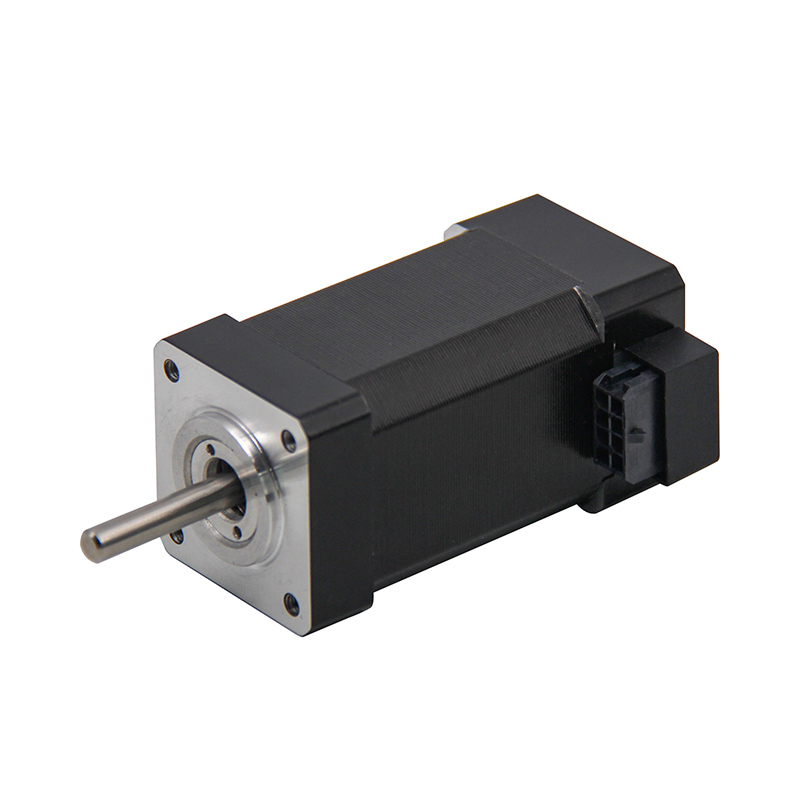
Performance metrics reveal distinct advantages for each motor type. Baolong Motor's brushless DC motor range spans 5W to 3KW with speeds reaching 5000 RPM, delivering superior power density. The company's 28mm square series generates 12-24W while maintaining compact dimensions—ideal for space-constrained robotics.
Stepper motors excel in torque delivery at low speeds. Baolong's hybrid stepper series provides holding torque without power consumption, a critical advantage for vertical-axis applications. The 23HS series produces 0.2-0.6 N·m at standstill, ensuring load security without continuous energy draw.
Efficiency comparisons show BLDCs consuming 20-30% less power than steppers for equivalent work output. However, steppers eliminate encoder costs ($50-$200 per unit), creating total cost advantages in simpler applications. A collaborative robot manufacturer reported 15% energy savings after switching high-duty-cycle joints to BLDCs while retaining steppers for intermittent positioning tasks.
Which Motor Type Offers Better Precision and Accuracy?
Precision requirements often dictate motor selection. Stepper motors deliver exceptional repeatability—Baolong's hybrid steppers maintain ±5% step accuracy across their entire range. This inherent precision comes without additional sensors, making steppers the default choice for 3D printers, CNC routers, and automated dispensing systems.
BLDCs achieve comparable or superior accuracy but require encoder integration. High-resolution encoders (2500+ pulses per revolution) enable BLDCs to match stepper precision while maintaining speed advantages. Medical device manufacturers frequently select encoder-equipped BLDCs for surgical robots where both precision and dynamic response matter.
Resolution comparison: A 200-step stepper provides 1.8° resolution natively (0.9° in half-step mode). A BLDC with 2500-count encoder delivers 0.144° resolution, offering finer positioning capability. However, system cost increases $150-$300 per axis due to encoder and controller complexity.
What Are the Cost Implications for Different Automation Projects?
Total cost of ownership extends beyond initial purchase price. Entry-level stepper systems start at $30-$80 per axis (motor + basic driver), making them attractive for budget-conscious projects. Baolong's 8HY series exemplifies this value proposition, delivering reliable performance in compact form factors.
BLDC systems require higher initial investment—$100-$400 per axis including motor, encoder, and sophisticated driver electronics. However, operational cost savings accumulate over time. A textile automation case study documented 25% annual energy savings after converting from steppers to BLDCs on continuously-running spindle drives.
Long-term value factors:
Stepper motors: Lower maintenance (no brushes), simpler replacement, reduced training costs
BLDCs: Extended service life (50,000+ hours), lower heat generation, reduced cooling requirements
Break-even analysis: BLDC investment recovers in 18-24 months for high-duty-cycle applications
How Do Speed and Torque Characteristics Influence Motor Selection?
Speed-torque profiles reveal fundamental design differences. Stepper motors deliver maximum torque at zero speed, with torque declining as speed increases. Baolong's 17HS series maintains strong torque up to 1500 RPM but experiences significant drop-off beyond this point—a phenomenon called "mid-range instability."
BLDCs provide relatively flat torque curves across their speed range. Baolong's 17WLSE series sustains 0.1-0.3 N·m from standstill through 3000 RPM, enabling consistent performance in variable-speed applications. This characteristic proves crucial for conveyor systems, robotic joints, and servo-driven equipment.
Application matching guidelines:
Choose steppers when: Speeds remain below 2000 RPM, frequent stop-start cycles occur, holding torque without power matters
Choose BLDCs when: Continuous high-speed operation required, dynamic speed changes common, efficiency critical
Hybrid approach: Many systems use steppers for positioning axes and BLDCs for propulsion/spindle drives
Performance Data Table
| Characteristic | Stepper Motor | Brushless DC Motor |
|---|---|---|
| Typical Speed Range | 0-2000 RPM | 0-5000+ RPM |
| Efficiency | 50-70% | 85-90% |
| Torque at Standstill | Maximum (100%) | Requires power (80-100%) |
| Position Accuracy | ±5% step angle | ±0.01° (with encoder) |
| Control Complexity | Simple (open-loop) | Advanced (closed-loop) |
| Noise Level | Moderate (40-50 dB) | Low (30-40 dB) |
| Maintenance | Minimal | Minimal |
| Cost (Entry System) | $30-$80 | $100-$400 |
What Role Does Control System Complexity Play in Motor Selection?
Control architecture significantly impacts implementation difficulty and cost. Stepper motors operate effectively in open-loop configurations—the controller sends step pulses without feedback verification. This simplicity accelerates development and reduces debugging time, particularly valuable for rapid prototyping and simple automation tasks.
BLDC controllers require sophisticated algorithms—field-oriented control (FOC) or trapezoidal commutation. Modern drivers integrate these algorithms, but tuning parameters demands expertise. Baolong provides matched driver solutions for their motor ranges, simplifying integration while maintaining performance optimization capabilities.
Integration considerations:
Stepper systems: Minimal tuning, predictable behavior, easier troubleshooting
BLDC systems: Parameter tuning required, superior dynamic response after optimization
Development time difference: Stepper projects typically launch 2-4 weeks faster
Long-term advantages: BLDCs offer better performance adaptation to changing loads
How Do Environmental Factors Affect Motor Performance?
Operating conditions dramatically influence motor reliability and lifespan. Stepper motors generate significant heat during operation—internal resistance and continuous current flow create thermal challenges. Baolong's IP44-rated planetary gearbox steppers address this through enhanced heat dissipation design, but thermal management remains critical in enclosed spaces.
BLDCs run cooler due to higher efficiency—less energy converts to waste heat. Baolong's brushless range includes IP65-rated options for harsh environments, featuring sealed housings protecting against dust and moisture ingress. This makes BLDCs preferable for food processing, medical, and outdoor automation applications.
Environmental performance factors:
Temperature rise: Steppers typically 30-50°C above ambient, BLDCs 20-35°C
Vibration tolerance: Both motor types handle industrial vibration well when properly mounted
Contamination resistance: BLDCs (especially outer-rotor designs) better suited for dusty environments
Humidity impact: Sealed BLDCs outperform standard steppers in high-humidity conditions
Which Motor Technology Best Serves Specific Industries?
Industry-specific requirements often determine optimal motor choice. Medical device manufacturers increasingly favor BLDCs for surgical robots and diagnostic equipment due to smooth operation, low acoustic noise, and precise speed control. Baolong supplies brushless solutions to medical OEMs requiring sterilizable housings and biocompatible materials.
Textile automation presents mixed requirements. Baolong's industrial control solutions demonstrate this diversity—textile companies use steppers for precise fabric positioning and BLDCs for high-speed spinning operations. The 23HSM stepper-servo hybrid bridges both needs, combining stepper simplicity with improved dynamic response.
Industry-specific preferences:
Collaborative robots: 80% use BLDCs for joint actuation (superior back-driveability and safety)
3D printing: 95% employ steppers (cost-effective precision)
CNC machinery: Hybrid approach—steppers for positioning, BLDCs for spindles
Logistics conveyor systems: BLDCs dominate (efficiency and speed requirements)
What Are Common Application Mistakes to Avoid?
Motor selection errors cost time and money. Oversizing steppers represents a frequent mistake—engineers specify motors with excessive torque margin, increasing cost and heat generation unnecessarily. Baolong's application engineers recommend 30-50% torque safety margin rather than 100%+ oversizing common in conservative designs.
Undersizing BLDCs creates opposite problems. Without proper acceleration profile calculations, undersized BLDCs stall under load or trip overcurrent protection. Proper sizing requires detailed load analysis including inertia calculations, friction coefficients, and duty cycle understanding.
Critical selection errors:
Using steppers above 3000 RPM where resonance causes reliability issues
Selecting BLDCs for simple positioning tasks where stepper cost advantages dominate
Ignoring thermal management in enclosed stepper applications
Neglecting encoder resolution requirements in BLDC positioning systems
Failing to account for voltage drop in long cable runs
How Should Engineers Approach the Selection Process?
Systematic evaluation prevents costly mistakes. Start with application requirements: Define speed range, positioning accuracy, duty cycle, and environmental conditions. Baolong's 20+ years of motor manufacturing experience has identified these as the primary decision factors affecting motor selection success.
Create a decision matrix weighting critical factors:
Speed requirements: >2500 RPM favors BLDCs
Precision needs: Microstepping (<0.9°) suggests steppers
Duty cycle: >50% continuous operation favors BLDCs
Budget constraints: Limited budgets lean toward steppers
Energy costs: High electricity costs justify BLDC investment
Prototype testing recommendations: Request motor samples from manufacturers like Baolong for real-world validation. Bench testing under actual load conditions reveals performance characteristics difficult to predict from datasheets alone. Many engineers report specification verification preventing 30-40% of field failures.
What Future Developments Will Impact Motor Technology?
Emerging technologies blur traditional distinctions between motor types. Closed-loop steppers combine stepper motor construction with encoder feedback, delivering near-BLDC performance at intermediate cost points. Baolong's stepper-servo motor line exemplifies this trend, offering low vibration and high efficiency while maintaining stepper motor simplicity.
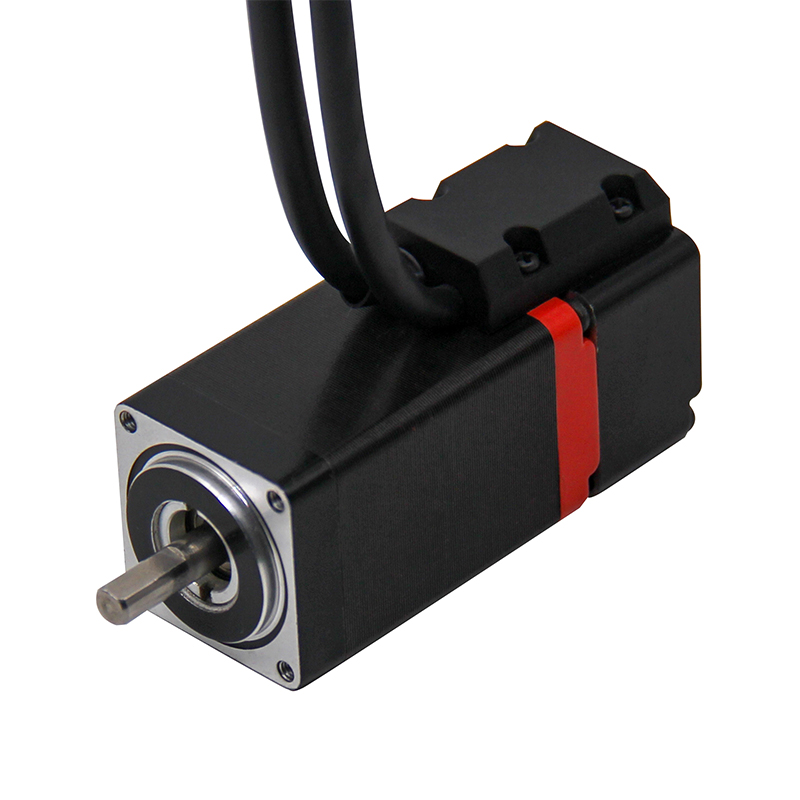
Integrated motor-driver units reduce installation complexity and wiring costs. Baolong's stepper and brushless motors with integrated drivers eliminate external driver mounting, saving panel space and reducing electromagnetic interference. Industry analysts project integrated units capturing 40% of the automation motor market by 2028.
Technology trend implications:
AI-optimized controllers will auto-tune BLDC systems, reducing setup expertise requirements
Wireless motor communication protocols will simplify multi-axis installations
Higher-voltage motors (up to 400VAC) will enable more compact high-power designs
Sustainable manufacturing focus will favor efficient BLDCs despite cost premiums
Ready to Select the Perfect Motor for Your Project?
Baolong Motor has supplied precision motion solutions to 1,000+ global partners across collaborative robotics, medical devices, textile automation, and industrial control applications. With 20+ years of manufacturing expertise and a complete product range from 5W to 3KW, Baolong delivers customized motor solutions tailored to specific application requirements.
Why Partner with Baolong:
✓ In-house R&D team providing technical consultation
✓ Complete product portfolio: square/round brushless motors, hybrid steppers, planetary gearbox options
✓ Customization capabilities: shaft configurations, encoder options, IP65 environmental protection
✓ 17,000 m² factory with 200+ production equipment ensuring quality and capacity
✓ Global support: Fast response times and comprehensive after-sales service
Frequently Asked Questions
Can stepper motors replace brushless DC motors in high-speed applications?
Stepper motors become inefficient above 2000-2500 RPM due to torque drop-off and increased resonance issues. While microstepping extends usable speed range, BLDCs remain superior for continuous high-speed operation. Applications requiring speeds exceeding 3000 RPM should exclusively consider brushless DC motor solutions.
What is the typical lifespan difference between steppers and BLDCs?
Both motor types offer 50,000+ hours operational life when properly specified and maintained. BLDCs may edge ahead slightly due to lower operating temperatures reducing bearing wear. However, environmental factors and load conditions impact lifespan more significantly than motor type selection. Baolong motors undergo comprehensive durability testing ensuring reliable long-term performance.
Do brushless motors require more maintenance than stepper motors?
Both technologies require minimal maintenance—neither uses brushes that wear and require replacement. BLDCs may require occasional encoder cleaning in contaminated environments, while steppers need no regular maintenance beyond bearing lubrication (typically factory-sealed). Total maintenance costs prove comparable over typical 10-year equipment lifecycles.
How does gearbox integration affect motor selection?
Planetary gearboxes multiply torque while reducing speed, enabling smaller motors to handle larger loads. Baolong offers both stepper and brushless motors with integrated planetary reduction. Gearboxes benefit steppers by extending effective speed range and BLDCs by increasing torque density. The 3:1 to 100:1 reduction ratios available accommodate diverse application requirements.
What encoder resolution is necessary for BLDC positioning applications?
Encoder resolution requirements depend on mechanical system resolution needs. For applications requiring positioning accuracy better than 0.5°, use encoders with 1000+ pulses per revolution. High-precision tasks (±0.01°) demand 2500-5000 count encoders. Baolong provides motors with multiple encoder options including photoelectric, magnetic, and resolver types matching specific application accuracy requirements.
Can one motor type completely replace the other?
No single motor technology optimally serves all applications. Steppers excel in cost-sensitive positioning applications with moderate speed requirements. BLDCs dominate high-speed, high-efficiency continuous-duty scenarios. Many sophisticated automation systems employ both motor types strategically—using each technology where its advantages create maximum value.